 Anupam Shukla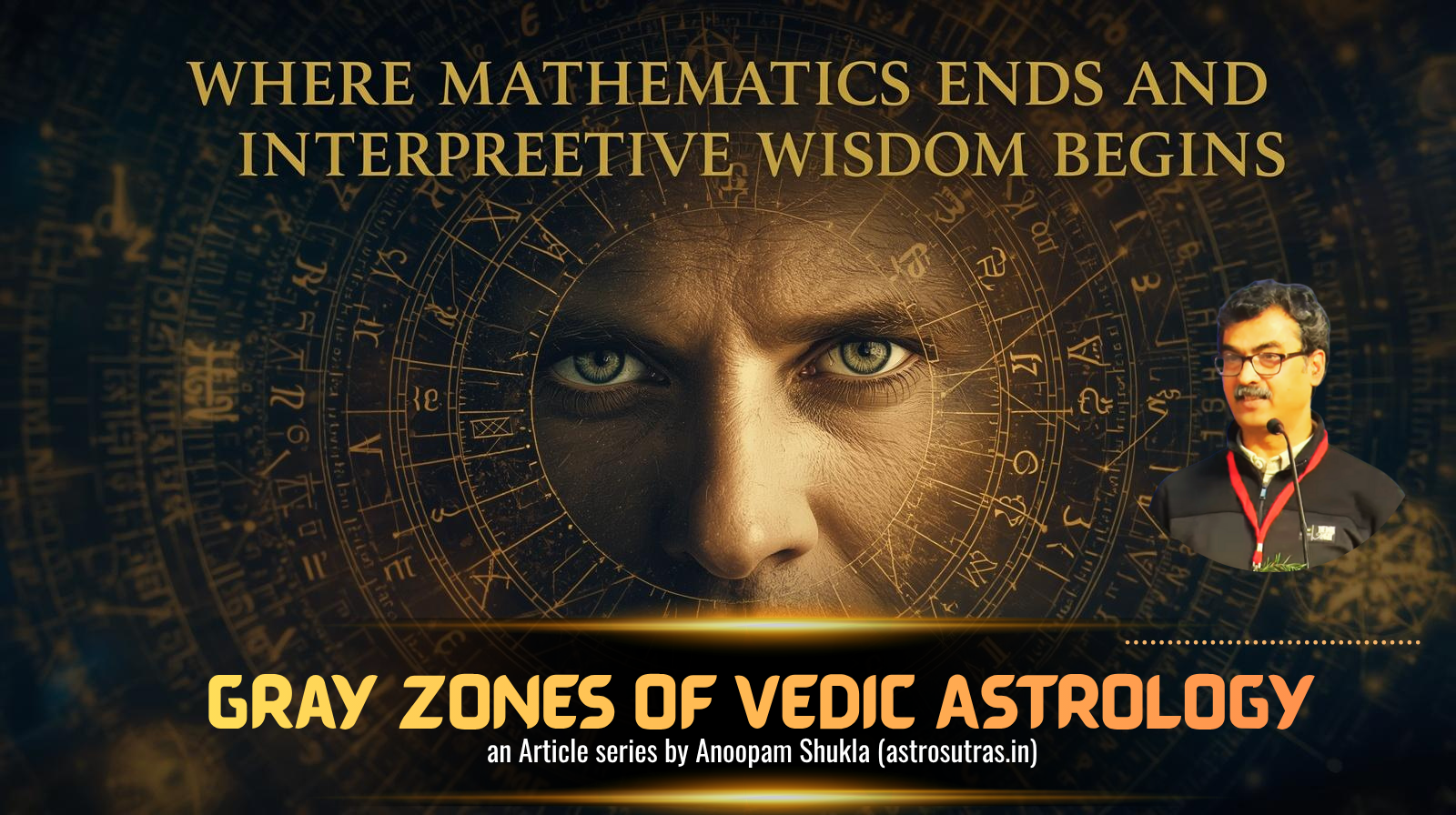
Gray Zones of Vedic Astrology
Where Mathematics Ends and Interpretative Wisdom Begins
The most fascinating aspect of Vedic astrology is that it stands simultaneously on two pillars — science and art. This duality itself creates the “gray zones” of astrology, where fixed mathematical structures interact with human interpretation, intuition, and experiential synthesis.
At the foundation of every horoscope lie three primary attributes: Bhavas (houses), Rashis (signs), and Grahas (planets). These are not random symbolic entities. They are structured components embedded within the cosmic framework of a birth chart. Each of them carries a specific role, nature, and field of operation, and together they continuously interact with one another to shape the dimensions of human life — sometimes gracefully, sometimes painfully.
The Bhavas define the areas of life, the Rashis define the environmental qualities and behavioral patterns, while the Grahas act as dynamic forces executing karmic indications. When these three attributes combine in a specific pattern, they begin to speak to each other through relationships, aspects, conjunctions, dignity, and dispositor chains. This interaction produces what classical astrology calls a Sutra — a formulation capable of generating a predictable outcome.
Here lies the scientific foundation of astrology.
The planets move in precise rhythms governed by astronomical laws. Their motion is mathematical, disciplined, and measurable. The horoscope itself is created through exact calculations based on planetary longitude, time, space, and celestial geometry. In this sense, astrology is deeply rooted in mathematics and cosmic order. Nothing in the chart is accidental.
However, the moment an astrologer begins interpreting these combinations, another dimension emerges — the dimension of synthesis.
Two astrologers may observe the same planetary combination yet arrive at different conclusions. Why does this happen? Because interpretation is influenced not only by classical formulations but also by experience, observation, intellectual conditioning, intuitive perception, and what may be called “astrological muscle memory.” Over years of practice, astrologers develop their own internal rulebooks based on repeated examination of charts and outcomes.
This is where astrology enters its gray zone.
A Sutra may indicate potential, but the depth, intensity, timing, and manifestation of that potential depend upon the astrologer’s ability to synthesize multiple layers simultaneously. A planet cannot be judged in isolation. Its sign placement, house ownership, Nakshatra, divisional dignity, aspects, conjunctions, transit triggers, and Dasha activation all modify the final expression. The challenge lies not in calculation, but in interpretation.
Thus, horoscope reading becomes an art of layered decoding.
The mathematics provides the structure; the astrologer provides the synthesis. One can calculate planetary positions with absolute precision, yet translating those positions into human experience requires interpretative wisdom. This interpretative space — between fixed cosmic mathematics and subjective human understanding — is the true gray zone of Vedic astrology.
Therefore, astrology cannot be reduced merely to blind faith, nor can it be treated entirely as a rigid science. It exists in an intermediate realm where mathematical certainty meets symbolic intelligence. The planets follow immutable cosmic laws, but their expression through human life demands insight, contextual understanding, and experiential maturity.
In essence, the horoscope is mathematical in construction, but astrological prediction is artistic in execution.
And perhaps this is what makes Vedic astrology both powerful and endlessly mysterious.
To be continued…
About the Author


 Jatinder Pal Singh Sandhu