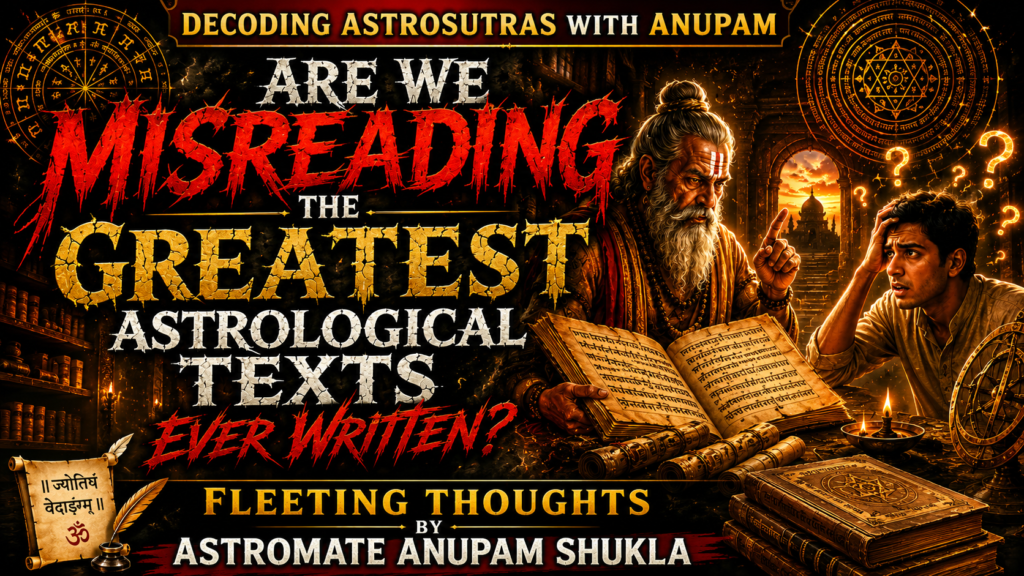
Are We Misreading the Greatest Astrological Texts Ever Written?
 Anupam Shukla
Are We Misreading the Greatest Astrological Texts Ever Written?
Astrology · Ancient Wisdom · Critical Inquiry
“We’ve been reading the stars for millennia — but have we ever truly read the books?”
A Critical Examination · Ancient Scriptures, Modern Failures · Long Read
We live in a time when astrology is being compressed, packaged, and sold minute by minute. Rapid forecasts, result-oriented predictions, psychological appeasement on demand — the market has spoken, and astrology has largely obeyed. But this creates an uncomfortable question: has astrology drifted from being a sacred, reflective science into a customer-driven behavioural tool built for quick answers?
And if so — is the problem with the ancient texts themselves? Or with how dramatically we are failing to read them?
“What appears as a direct statement in these texts is, in reality, a coded theorem — not a literal prescription.”
The horary trap
When one question is never enough
Much of today’s astrological practice leans heavily on horary systems, many shaped by intercontinental influences. Yet these systems often draw from a single point of information — the moment a question is asked — ignoring the complex web of conditions surrounding it.
Richer traditions like Swar Shastra, Omens, Tajik, and Nadi offer multi-dimensional inputs. But modern application has narrowed everything down to probabilistic end results, which frequently miss the mark. With AI now entering the space, even these limited-variable prediction models face an existential reckoning — unless they are re-rooted in deeper logic.
Force one
The pre-coded horoscope — static potential embedded at birth
Force two
The conditioning environment — dynamic atmospheric forces in play
Force three
The native’s karmic and psychological readiness — free will and maturity
The lost soul
Precondition, process, result
In its original essence, astrology is not a mechanical chart-decoding exercise. It is a living interaction between the three forces above. Any result is the product of all three — not one. This dynamic integration, this process, is the real soul of astrology. And it is almost entirely absent from new-age approaches and digital tools.
The texts
Never straightforward — always layered
This brings us to the most provocative question of all. Do classical texts like Brihat Parashara Hora Shastra, the Jaimini Sutras, or Phaladeepika actually explain the sequence of Precondition → Process → Outcome? Or do they present verses in a deceptively simple tone that demands multilayered decoding? The answer is the latter. Every verse is an invitation to explore the conditional logic behind planetary relationships, the environmental triggers for any outcome, and the maturity state of planets, houses, and the native’s own consciousness. These texts are not obsolete. They are simply underexplored — through the wrong lens
“The eternal algorithms of cosmic truth are still there, waiting inside the core texts. The question is whether we are ready to stop reading them on the surface.”
The path forward
Conditional thinking as the new standard
If we accept that classical verses hint at conditional formulations, we must also admit that most practitioners have never approached these texts with that mindset. The real work is this: to decode the ecosystem that supports or negates a result; to trace the patterns of precondition that activate embedded planetary codes; to document what we find so the next generation inherits not just the verses, but the living logic behind them.
Have we truly approached these texts with the intention to decode conditioning patterns, inter-relational dynamics, and time-sensitive processes? If yes — we must begin compiling and sharing those discoveries. If no — it is time we did.
The eternal algorithms of cosmic truth are still encoded in the core texts — waiting not for a better sky, but for a better reader.
About the Author

 Jatinder Pal Singh Sandhu