Read Time:2 Minute, 12 Second
Understanding Dainya Parivartan Yoga and the Role of Trishadaya Lords
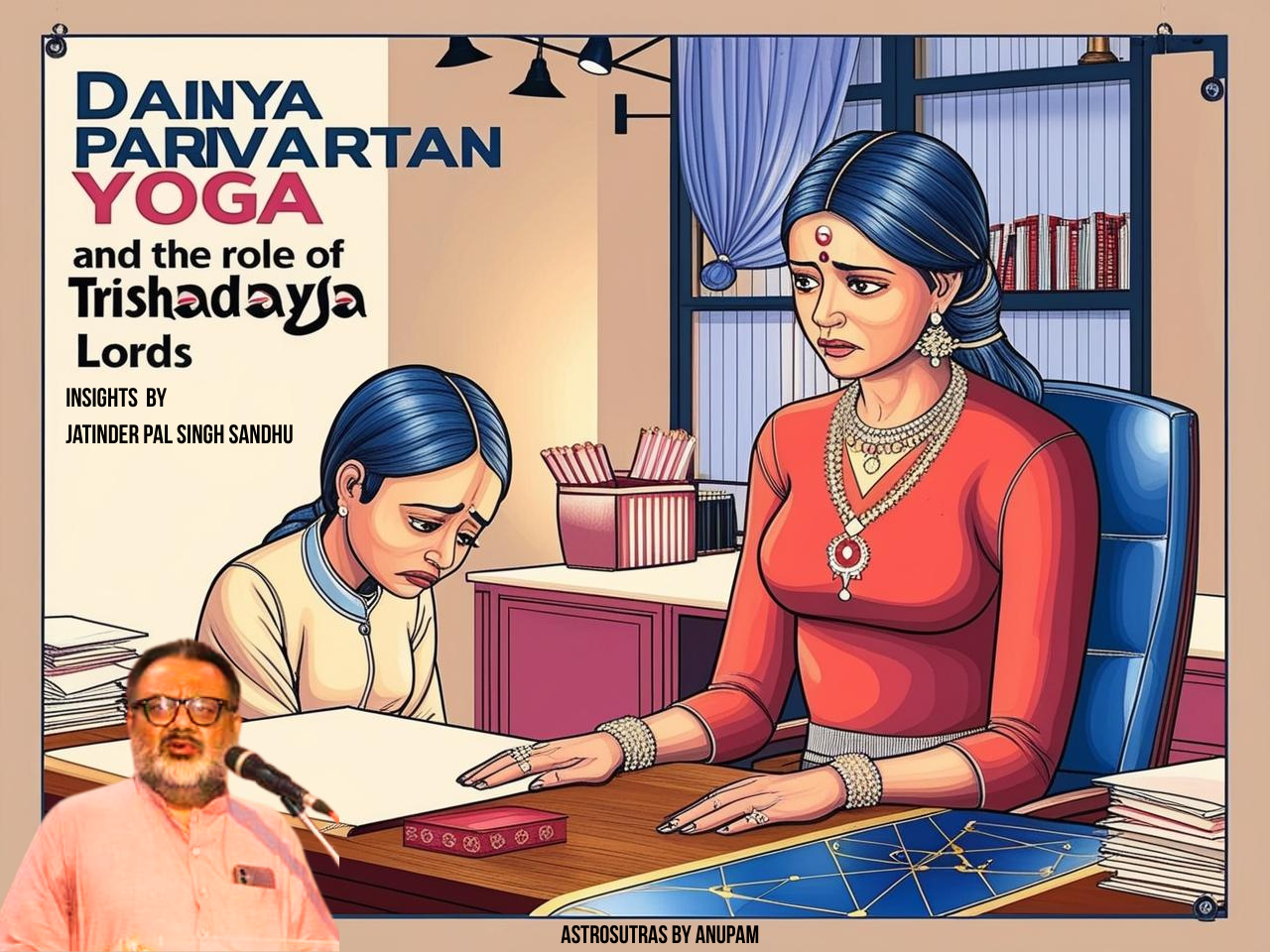
Understanding Dainya Parivartan Yoga and the Role of Trishadaya Lords
Dainya Parivartan Yoga is formed when the lords of the 3rd, 6th, 8th, and 12th houses (commonly associated with obstacles, debts, transformation, and loss) are involved in mutual exchange with the lords of kendras (1st, 4th, 7th, 10th) or konas (1st, 5th, 9th), or even among themselves.
According to Maneeshwara in Phaladeepika, among the Trishadaya houses (3rd, 6th, and 11th), the 11th lord features in two specific Dainya exchanges—namely, when:
- The 11th lord exchanges with the 6th lord
- The 11th lord exchanges with the 12th lord
Now, consider a scenario where the 8th lord exchanges with the 11th lord. Wouldn’t such a combination be even more dissipative and destabilizing than the standard Dainya Yoga? After all, the 8th house governs sudden upheavals, secrets, and longevity, and its combination with the house of gains and ambitions (11th) could distort the promise of both houses.
A promising and practicing astrologer once raised the valid point that Trishadaya lords are not inherently malefic in all circumstances. I agree—but with a caveat: under certain specific conditions, especially when they are:
- In their own signs or
- Functioning as benefic planets
They can offer positive outcomes. Malefic planets, when placed in their own houses, strengthen the house they occupy, but their aspects can remain harmful. They simultaneously expand and restrict the results of the houses they influence—this is particularly true for Saturn and the Sun, which have separatist tendencies. Mars, while boosting strength, can still impart a malefic influence through its aspects.
Case Examples:
- Take Jupiter in the 3rd house for a Libra Ascendant. As the lord of both the 3rd and 6th houses, its aspects on the 7th, 9th, and 11th can actually enhance those houses.
- Now consider Saturn in Capricorn (its own sign) in the 3rd house for a Scorpio Ascendant. Its aspect on the 5th and 9th can lead to degeneration in those bhavas despite its own strength.
Another scenario: if the 3rd lord is placed in an adverse sign or house (i.e., from where it has no strength or relevance), can it still support the house it owns? Certainly not, unless it is in conjunction (yuti) with a Yogakaraka or a Trikona lord, or both.
Important Note:
When Laghu Parashari claims that Trishadaya lords are always malefic, we must take a moment to understand the author’s intention and framework. The classification is likely based on their inherent tendency to disturb or distract the flow of evolution, not necessarily a blanket verdict in all charts and conditions.